Pixel pitch is often the first number discussed in an LED facade proposal - and one of the easiest to misunderstand. A smaller pitch places more pixels into every square metre, but that does not automatically make it the right choice. On a large building, the extra resolution may be invisible from the street while still increasing equipment, cabling, control, installation, and maintenance requirements.
The sensible target is not the finest available pitch. It is the coarsest pitch that can reproduce the intended content convincingly from the closest important viewing area.
For preliminary planning, many designers use a simple screening rule: a pitch of P millimetres begins to form a coherent image at roughly P metres. A P50 mesh facade, for example, is normally evaluated from around 50 metres or farther. This is only a starting point. Text size, screen dimensions, brightness, viewing angle, facade transparency, and the type of content can all move the practical distance in either direction.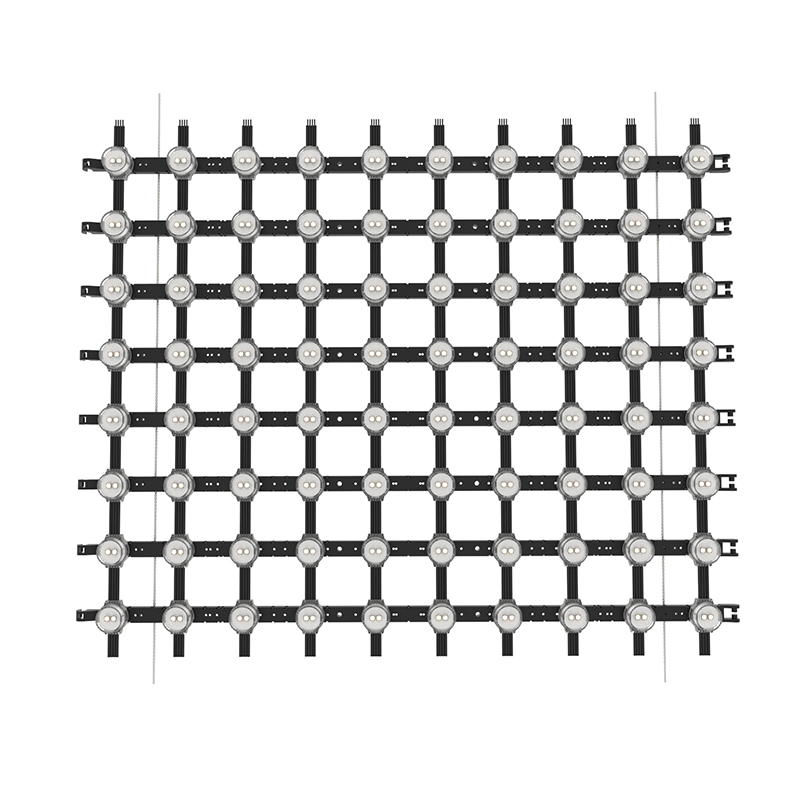
Pixel pitch is the centre-to-centre spacing between adjacent pixels, stated in millimetres. P40 means that neighbouring pixel centres are 40 mm apart. If the horizontal and vertical spacing are equal, pixel density can be estimated with:
Pixel density (pixels/m²) = 1,000,000 ÷ pitch² (mm)
This relationship is not linear. Reducing the pitch from 50 mm to 25 mm does not double the number of pixels; it produces four times as many pixels per square metre.
Some architectural mesh products use different horizontal and vertical spacing. In that case, use:
Pixel density (pixels/m²) = 1,000,000 ÷ (horizontal pitch × vertical pitch)
Always check both values on the technical drawing. A single marketing label may not describe the complete pixel geometry.
The following figures assume equal horizontal and vertical spacing. Viewing ranges are preliminary design bands, not acceptance criteria; the final selection should be checked with project content and a full-scale sample.
|
Nominal pitch |
Approx. pixels/m² |
Pixel density vs. P50 |
Preliminary viewing range |
Common project profile |
|
P25 |
1,600 |
4.00× |
20-40 m |
Detailed commercial media, closer urban viewing |
|
P40 |
625 |
1.56× |
40-80 m |
Retail complexes, plazas, medium-size facades |
|
P50 |
400 |
1.00× |
50-100 m |
General-purpose media facades and branded animation |
|
P62.5 |
256 |
0.64× |
60-125 m |
Large buildings with a stronger transparency requirement |
|
P80 |
156 |
0.39× |
80-160 m |
Towers, stadium exteriors, long-distance viewing |
|
P100 |
100 |
0.25× |
100 m and beyond |
Landmark-scale light art, bold graphics and colour effects |
P125 and P150 can be appropriate when a facade is extremely large and the content is deliberately simple. At these pitches, the installation behaves more like a dynamic architectural lighting surface than a conventional video screen.
Building height is useful context, but it does not determine pitch by itself. A 100-metre tower beside a narrow pedestrian plaza may have a much shorter critical viewing distance than a 30-metre building beside a motorway.
Map the actual audience before comparing products:
The last question is important. A tall facade may not need one uniform pitch. In some projects, a denser lower zone and a more open upper zone can preserve close-range detail while reducing weight and pixel count. That approach requires careful content mapping and calibration, but it can be more rational than specifying the finest pitch across the entire elevation.
Pixel pitch should be translated into the total canvas available to the content team. For equal pitch in both directions:
Horizontal pixels = display width (m) × 1,000 ÷ pitch (mm)
Vertical pixels = display height (m) × 1,000 ÷ pitch (mm)
Consider a facade that is 30 m wide and 18 m high:
|
Pitch |
Native resolution |
Total pixels |
|
P25 |
1200 × 720 |
864,000 |
|
P40 |
750 × 450 |
337,500 |
|
P50 |
600 × 360 |
216,000 |
|
P62.5 |
480 × 288 |
138,240 |
|
P80 |
375 × 225 |
84,375 |
|
P100 |
300 × 180 |
54,000 |
This calculation often changes the discussion. P50 may sound coarse when judged by its spacing alone, yet a 30 × 18 m installation still creates a 600 × 360 canvas. That is adequate for large logos, silhouettes, colour fields, slow-moving typography, and purpose-made animation viewed from the intended distance.
It is not a Full HD canvas, and it should not be treated like one. Playing a 1920 × 1080 advertisement without adapting it can make small captions disappear and thin graphic elements flicker. Content should be designed or reformatted at the facade's native aspect ratio and tested at native pixel resolution.
On the same 30 × 18 m facade, P31.25 provides 552,960 pixels, while P50 provides 216,000. The finer option therefore drives 2.56 times as many pixels.
That figure does not mean the complete project will cost exactly 2.56 times more or consume 2.56 times more power. LED package efficiency, brightness settings, drive method, product construction, content, and duty cycle all affect the result. It does show why a pitch decision changes much more than image sharpness: it also changes the scale of the electronic and data system.
Different content places very different demands on a mesh facade.
Text deserves special attention. Letter height, stroke width, contrast, and display time matter as much as pitch. A bold word occupying one-third of the facade can remain clear on a relatively open grid; a paragraph will fail even on a considerably finer mesh. If readable copy is a core requirement, ask the content designer for the smallest proposed text and test that exact asset - not a colourful demo reel supplied by the screen manufacturer.
An LED mesh facade is selected partly because it allows light, air, and outward views to pass through the display. Finer pitch usually adds more LED nodes, cables, and supporting material per square metre, which can reduce openness. Wider spacing generally improves transparency and can reduce the visual presence of the system during the day.
This trade-off affects more than appearance:
Do not compare transparency percentages without asking how they were measured. The useful figure is the open-area ratio of the installed system, including wires, frames, power boxes, and supporting structure - not just a bare display strip photographed in a laboratory.
Brightness and pixel pitch solve different problems. Pitch controls spatial detail; brightness controls luminance and contrast against ambient light. Increasing brightness will not make undersized text legible on a low-resolution canvas.
At the same time, the highest available brightness is not automatically desirable. Excessive night-time luminance can create glare, disturb nearby occupants, consume unnecessary energy, and conflict with local planning rules. A credible proposal should define:
Ask for performance at realistic operating temperature, not only a peak laboratory value. Colour consistency at reduced night brightness is also worth checking, because many facades spend more hours dimmed than operating at maximum output.
Two mesh displays with the same nominal pitch can look very different. Evaluate the complete optical and electronic system, including:
A well-calibrated P50 system with suitable optics can produce a more convincing facade than a poorly matched P31.25 system. Pitch defines the sampling grid; it does not guarantee image quality.
Record the nearest critical viewing point, the main viewing band, traffic speed, viewing angles, facade orientation, and day/night operating conditions. Use site drawings or measured distances rather than estimates from photographs.
Separate essential content from aspirational content. If names, prices, dates, or detailed products must be readable, specify their smallest acceptable on-screen size. If the goal is architectural animation, avoid paying for resolution the creative concept will not use.
Present the resulting pixel dimensions to the content team. Confirm that the proposed aspect ratio and resolution support the actual campaign assets.
For each candidate, compare transparency, total weight, wind-load data, connected load, estimated operating energy, controller capacity, maintenance access, and installed cost. Avoid making the decision from price per square metre alone.
View a full-scale sample from the closest critical distance and from at least one typical distance. Use the project's own logo, smallest text, skin tones, dark gradients, and low-brightness scenes. A phone video of a demo wall is not an adequate substitute because camera exposure and compression can hide pixel structure or exaggerate flicker.
Choosing the smallest pitch available. This can add cost and complexity without a visible improvement at the real viewing distance.
Using a viewing-distance formula as a guarantee. Rules of thumb are useful for shortlisting, but content, optics, contrast, visual acuity, and viewing angle still matter.
Ignoring total resolution. Pitch must always be evaluated together with the physical width and height of the display.
Designing content after procurement. Content requirements can change the correct pitch. Creative and engineering decisions should develop together.
Comparing bare-module specifications. Transparency, weight, power, and weather performance should describe the fully installed system.
Assuming daytime and night-time settings are identical. A facade needs a controlled luminance strategy, not one fixed output level.
A reliable pitch recommendation should be based on a project brief containing:
If a supplier recommends a pitch before requesting most of this information, the proposal is probably product-led rather than project-led.
No. A smaller pitch creates more resolution, but viewers may not perceive the difference from the intended distance. It can also increase pixel count, system complexity, and cost. The correct pitch is the one that meets the visual brief with an appropriate engineering and commercial margin.
P40 to P50 is a reasonable preliminary comparison range for many mesh-facade projects. Detailed advertising or small text may favour P40 or finer, while bold branded animation may work well at P50 or wider. Screen size, content, transparency, and viewing angle must be checked before final selection.
Yes, provided the screen is physically large enough and the video is designed for its native resolution. P80 is better suited to bold shapes, large subjects, strong contrast, and slower motion than to small captions or detailed product shots.
Divide the display dimension in millimetres by the pixel pitch. A 20 m-wide P50 display has 20,000 ÷ 50 = 400 horizontal pixels. Repeat the calculation for height. For products with unequal horizontal and vertical pitch, use the corresponding value for each direction.
Usually, but not automatically. Product construction, cable width, pixel housing, mounting frames, and power boxes also affect the installed open area. Compare drawings and installed-system data rather than nominal pitch alone.
The most effective LED facade is not the one with the most pixels. It is the one whose resolution, transparency, brightness, structure, content, and operating plan work as a single system.
Begin with measured viewing zones. Calculate the native canvas. Test real content. Then select the pitch that meets the visual objective without adding density the audience cannot use. That process produces a clearer specification, a more defensible budget, and a facade that performs as intended after the launch event is over.
Planning an architectural LED mesh project? Send us your facade dimensions, viewing-distance map, content examples, and installation conditions. Our engineering team can compare suitable pitch options and prepare a project-specific resolution and system proposal.