Skyscrapers and high-rise commercial structures exceeding 100 meters serve as defining landmarks of modern urban topographies. At night, these expansive facades present a high-value canvas for dynamic architectural lighting, brand communication, and generative media art.
However, implementing a reliable, high-definition media facade on a structure exceeding 100 meters presents severe engineering hurdles. Standard low-voltage commercial lighting topologies—perfectly adequate for low-to-mid-rise real estate—fail catastrophically when scaled vertically.
Addressing these challenges requires a structural transition away from legacy wiring methods toward low-loss DC48V intelligent linear matrices and centralized power-data control topologies.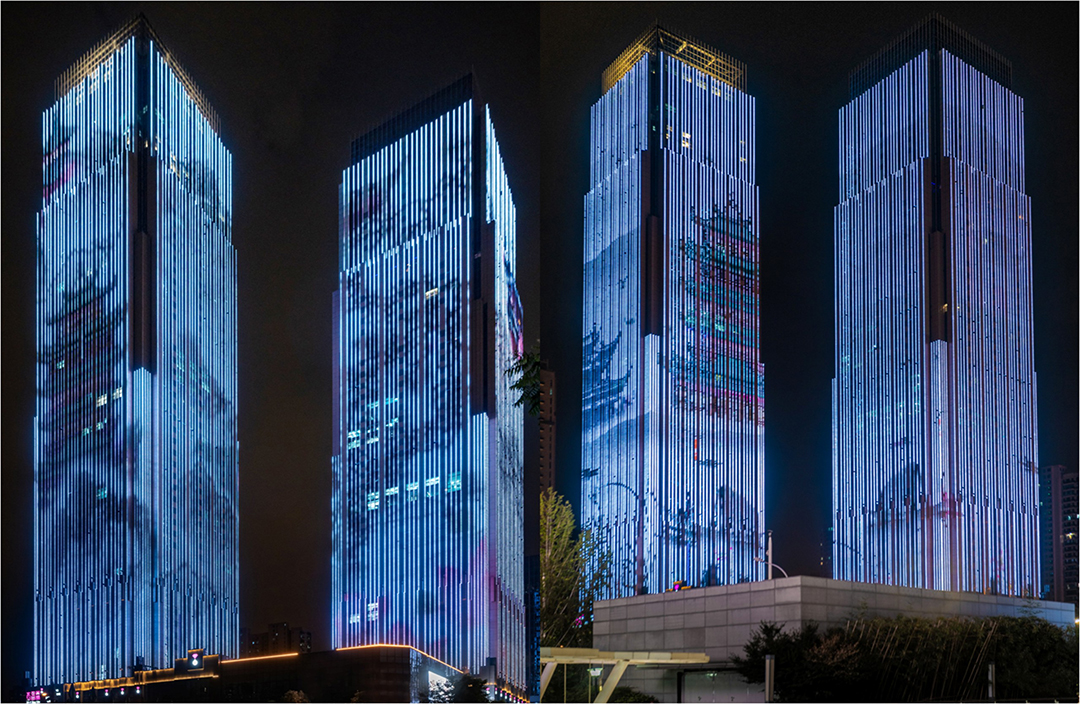
Conventional outdoor LED configurations operate on DC12V or DC24V distributions. When forced to cover vertical heights of 100m+, these topologies suffer from severe $I^2R$ power losses. Voltage drop degrades light consistency over distance, causing noticeble shifts in color temperature and lumen output between the bottom and top of a lighting loop. To counter this, legacy configurations require power supply installations every 5 to 15 meters, introducing excessive weight, material costs, and hundreds of vulnerability points across the exterior wall.
Delivering real-time dynamic video content or complex lighting sequences across an expansive exterior footprint requires precise signal delivery. Over extended structural spans, standard single-ended data protocols degrade due to electromagnetic interference (EMI) and line resistance, manifesting as flickering, signal delay, and visual desynchronization across the upper levels of the facade.
Supertall envelopes face intense external stresses. At heights over 100 meters, localized wind speeds can exert dynamic pressures corresponding to Category 12+ typhoons. Heavy lighting fixtures with large wind-catching cross-sections increase the structural load on curtain wall framing, while overly complex sub-frame installations extend high-risk labor hours during high-altitude operations.
To mitigate inline voltage loss and minimize external component weight, modern architectural lighting relies on unified DC48V power and data distributions.
Elevating the operating voltage to DC48V reduces the operational line current by half for identical power demands. This power profile directly limits voltage attenuation along the loop.
A single end-fed power line can cleanly power continuous cascading runs of 50 to 80 vertical meters without introducing visual lumen decay or color drift. This performance profile eliminates up to 75% of local external power drop enclosures, concentrating power management within controlled, indoor electrical rooms or technical service floors.
To maintain clean video synchronization over extended heights, advanced linear lights employ high-frequency differential signaling matched with automatic breakpoint resume function (dual-signal paths).
If an individual LED pixel experiences a mechanical fault or structural impact, the secondary control line instantly bypasses the compromised node. This architecture preserves downstream signal synchronization across the rest of the skyscraper envelope, avoiding localized system-wide dark spots.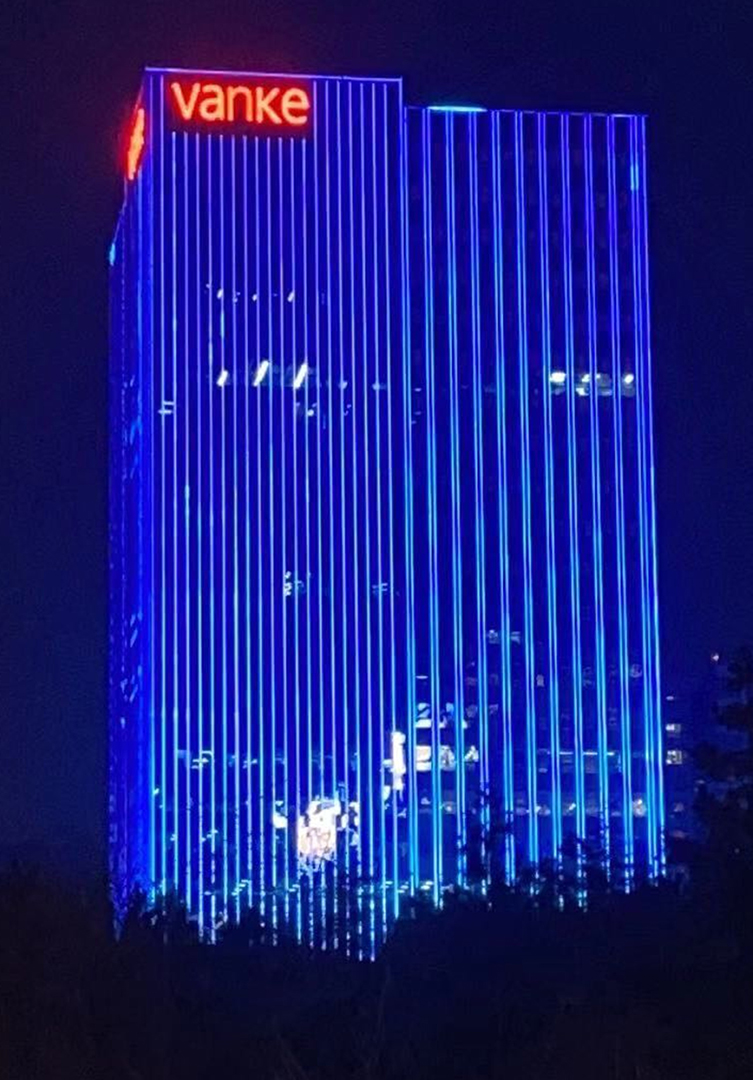
A primary objective for architects and façade consultants is maintaining the clean lines of the building envelope during the day. Lighting systems should not disrupt the original architectural rhythm.
Modern high-rise facade lighting solutions utilize slim, custom-extruded aluminum profile guide rails designed to interface directly with the curtain wall's vertical or horizontal mullions.
By utilizing interlocking, sliding track hardware and low-profile hidden fasteners, the entire structural support network, power line buses, and signal distribution tracks are completely hidden behind the active LED fixture layout.
From street level during the day, the building preserves its clean glass and metal finish. At night, the hidden infrastructure transforms into an expansive, high-density digital display panel.
| Engineering Parameter | Traditional DC24V Configuration | Advanced Centralized DC48V System |
| Max Continuous Single-End Run | 10 – 15 Meters | 50 – 80 Meters |
| Power Distribution Node Frequency | Every 12 Meters (External) | Concentrated on Service Floors (Internal) |
| System Weight Impact | High (~4.5 kg/m incl. subframes) | Ultra-Low (<1.8 kg/m via slim profiles) |
| Ingress Isolation Standard | IP65 / IP66 | IP67 / IP68 Continuous Dual Seal |
| Signal Integrity Path | Single-line serial (High failure risk) | Dual-line differential with auto-addressing |
By transferring power transformation components from the exposed exterior facade to centralized, climate-controlled internal service areas, the actual product arrays on the building exterior consist entirely of solid-state, long-life optoelectronic components.
Combined with an IP67/IP68 ingress rating—featuring structural silicone sealing and high-grade polycarbonate lens shields—this architecture delivers an operational life exceeding 50,000 hours, drastically lowering ongoing maintenance costs and maximizing the lifetime value of the architectural asset.
Super-high-rise building envelopes demand lighting solutions designed for extreme structural scaling. Resolving high-altitude challenges requires replacing disjointed low-voltage wiring arrays with streamlined DC48V power-data distribution networks.
By prioritizing high-voltage cascading runs, differential signal paths, and hidden architectural structural paths, commercial property developers can convert tall structural facades into reliable, low-maintenance digital media channels that capture maximum urban value.